

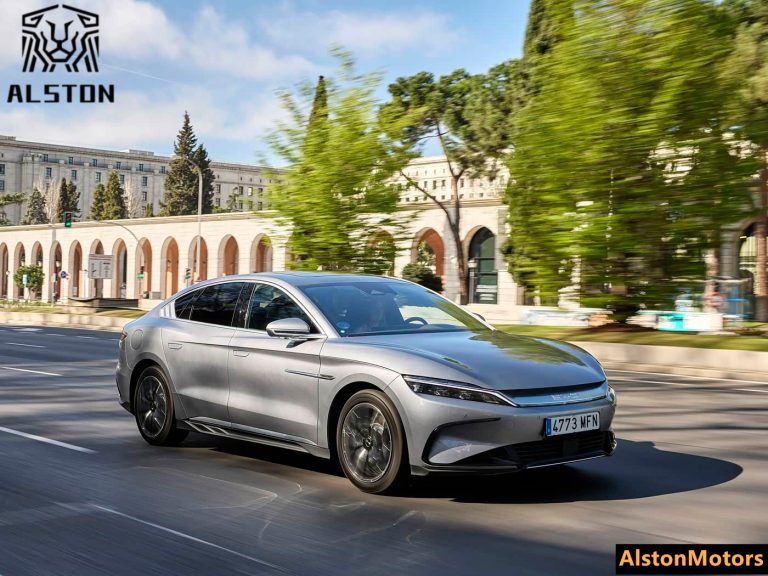
Oil Price Surge Drives Chinese Electric Vehicle Demand in UAE After Iran Conflict
AlstonMotors.com — Monday, March 30, 2026
Table of Contents
- Overview
- The oil shock: Strait of Hormuz blockade
- Chinese EV demand jumps in the UAE
- BYD’s position in the UAE
- Outlook
- Sources
Overview
A US-Israeli aerial campaign against Iran that began on February 28, 2026 has shut the Strait of Hormuz and sent oil prices above $100 per barrel. In the UAE, where Chinese automaker BYD had already established a fast-growing presence, dealers are reporting accelerating demand for electric vehicles as buyers calculate the rising cost of fuelling petrol cars. The trend is the most concentrated example in the Middle East of a broader pattern being tracked across Asia.
The oil shock: Strait of Hormuz blockade
The Strait of Hormuz normally transports around 20 million barrels per day of crude and refined products. Iran’s effective closure of the waterway since late February has caused Singapore gasoil to jump 104% to $186.43 per barrel and gasoline to rise 91% to a record $151.60, according to Reuters data published March 26. Brent crude was trading around $103.78 per barrel in Asian markets on March 25. The International Energy Agency has described the disruption as the largest global energy security challenge in modern history. Roughly 40% of oil imported across Asia passes through the Strait, placing the UAE and its neighbours at the centre of the supply crunch despite being oil exporters themselves.
Chinese EV demand jumps in the UAE
The UAE was already China’s second-fastest-growing EV export market in 2025, with approximately 192,000 Chinese-made vehicles sold, according to China Passenger Car Association data cited by Rest of World. Chinese brands including BYD, Nio, and GAC Aion raised their combined UAE market share to between 15% and 20% in the first nine months of 2025, up from 10% to 14% in 2024, per AutoData Middle East. Since the Iran conflict began, dealers across the region report a further acceleration as buyers weigh fuel savings against purchase price. BYD’s global overseas sales jumped 50% year-on-year in the first two months of 2026, and analysts at Third Bridge and BofA Securities attributed part of that growth to demand shifts driven by rising oil prices. BYD’s Hong Kong-listed shares rose nearly 12% in March, their best monthly gain in over a year.
BYD’s position in the UAE
BYD distributes vehicles in the UAE through Al-Futtaim Electric Mobility and set a target of selling 10,000 vehicles in the UAE in 2025. The brand’s executive vice president Stella Li demonstrated BYD’s 1,000 kW flash-charging technology in Dubai in September 2025, which can add 400 kilometres of range in five minutes. BYD also confirmed plans to deploy 600 ultra-fast chargers across the GCC, primarily in the UAE and Saudi Arabia, by end of 2026, with the first unit activated in Dubai. The UAE’s federal EV strategy targets a 50% electric vehicle mix by 2050. Dubai’s Roads and Transport Authority has separately committed to making 25% of all trips self-driving by 2030, creating additional commercial demand for connected EVs. Beyond BYD, Chinese brands Nio, Geely, GAC Aion, MG, and Chery all have active UAE distribution, providing buyers with a wide range of price points.
Outlook
Reuters columnist Clyde Russell, writing on March 26, argued that the lasting legacy of the Iran war for the region is likely to be a structural acceleration of the energy transition rather than a temporary demand spike. He cited the European experience after the 2022 Russia-Ukraine energy shock as a precedent: a short-term price crisis that produced a lasting shift in consumer and policy behaviour toward lower-carbon alternatives. In the UAE specifically, the Middle East and Africa EV market is projected to grow from $5.06 billion in 2026 to $20.39 billion by 2031, a compound annual growth rate of 32.15%, according to a Research and Markets report published March 18. Chinese OEMs are positioned to capture a disproportionate share of that growth, given their established distribution networks, competitive pricing, and existing flash-charging infrastructure commitments in the Gulf.
Sources
- Reuters via Mining.com — Iran war fuel crisis gives electric cars a long-term boost (March 26, 2026)
- Bloomberg — BYD Stock Rebound Gathers Pace as Oil Shock Drives EV Sales Boom (March 26, 2026)
- Bloomberg — BYD Showrooms Are Bustling Across Asia After Iran Oil Shock (March 19, 2026)
- Electrek — BYD’s big EV bet is paying off as drivers ditch gas with surging oil prices (March 20, 2026)
- Jianshi — Iran War Safe Haven: BYD Surges in March (March 27, 2026)
- GlobeNewswire / Research and Markets — Middle East & Africa EV Market report (March 18, 2026)
- AGBI — China’s BYD to join the queue in UAE autonomous vehicle push (September 25, 2025)
- Rest of World — Chinese electric vehicle exports surge as competition intensifies (February 10, 2026)
- Utilities Middle East — China drives UAE EVs (November 18, 2025)
- Wikipedia — Economic impact of the 2026 Iran war